
Officer Wellness Is Not Optional, It's Operational
Why policing’s future depends on shifting from break and replace culture to restoring the human operating system behind the uniform

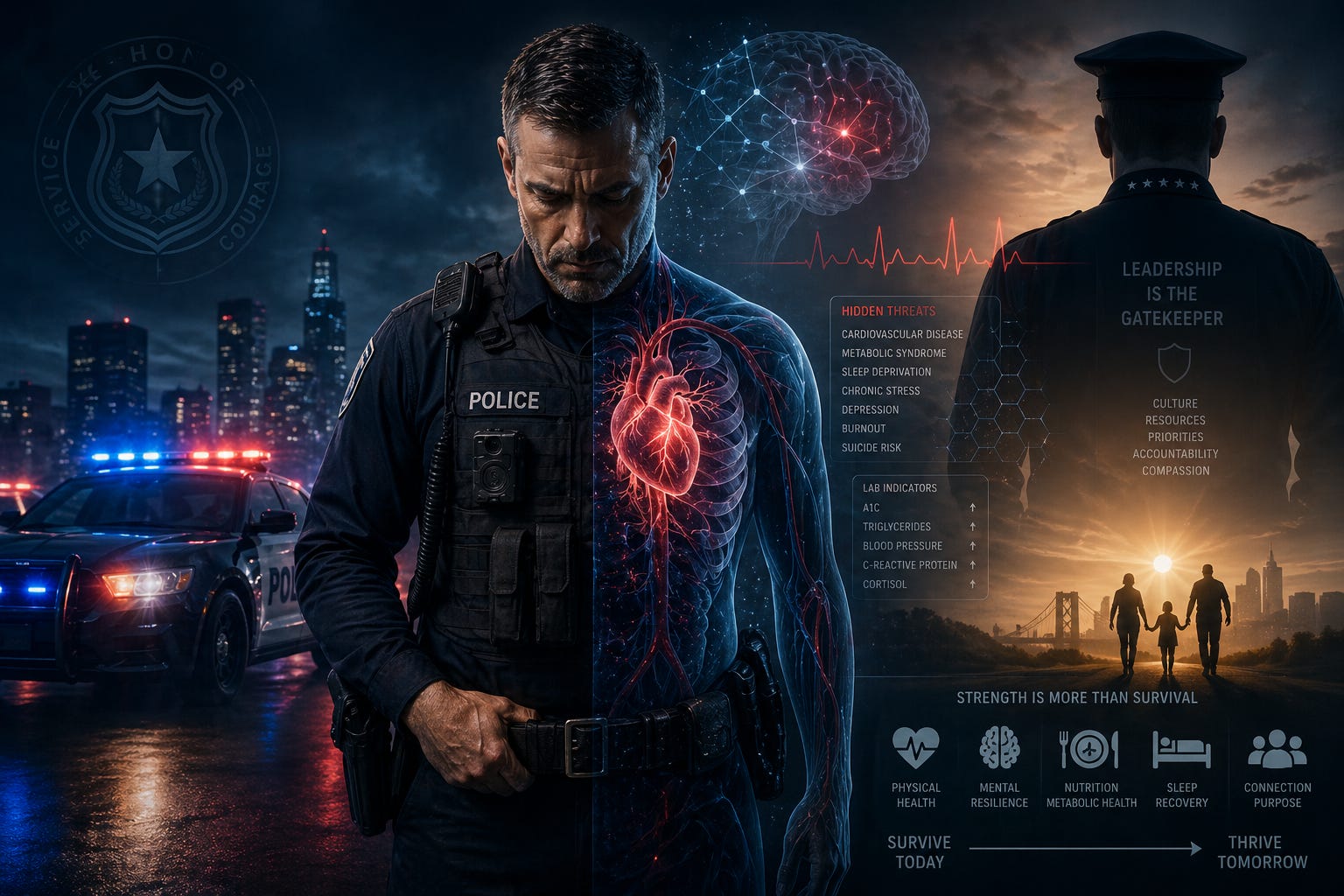
There is a truth in policing that should force every chief, sheriff, mayor, city council member, and public safety leader to pause.
Every year, law enforcement agencies across America dedicate mandatory hours to firearms qualifications, defensive tactics, emergency vehicle operations, bloodborne pathogens, domestic violence policy, legal updates, and equipment proficiency.
And they should.
Violent encounters are real. Ambushes are real. Vehicle crashes are real. The dangers of policing are real. But here is the deeper question:
Are our priorities aligned with actual risk?
Because if we truly care about officer safety, then our budgets, policies, and mandatory training requirements should reflect what is statistically most likely to kill our officers.
And right now, too often, they do not.
This is not necessarily because leaders do not care. More often, it is because policing inherited a system built to prioritize visible threats while often underestimating invisible ones. We built cultures around preparing officers for the boogeyman waiting on the traffic stop, the building search, the domestic violence call, or the suspicious movement in a dark alley. We trained to sit with our backs to the wall, study ingress and egress routes, watch hands, read behavior, and constantly prepare for violence.
Complacency kills.
That mindset has value. It saves lives. But what if the boogeyman is not the greatest threat to most officers over the course of their careers? What if the greatest threat is not always the suspect in front of them, but the physiological deterioration quietly happening inside them?
That is where this conversation becomes uncomfortable.
Because while violent assault is real, the broader mortality data paints a sobering picture. Research consistently shows that approximately 27 to 30 percent of law enforcement officers meet the criteria for metabolic syndrome, a dangerous cluster of conditions tied to cardiovascular disease, stroke, diabetes, cognitive decline, and premature death. At the same time, studies continue to suggest that officers are more likely to die by suicide than by felonious assault, while heart disease, chronic stress, and metabolic dysfunction remain among the profession’s most significant long-term killers.
This does not diminish tactical threats. It clarifies total risk.
If we are willing to invest heavily in preparing officers for threats that are statistically less likely than heart disease, suicide, or metabolic dysfunction, while failing to proportionally address the threats most likely to shorten their lives, then we may have built an upside-down model of officer safety.
Chronic or Acute?
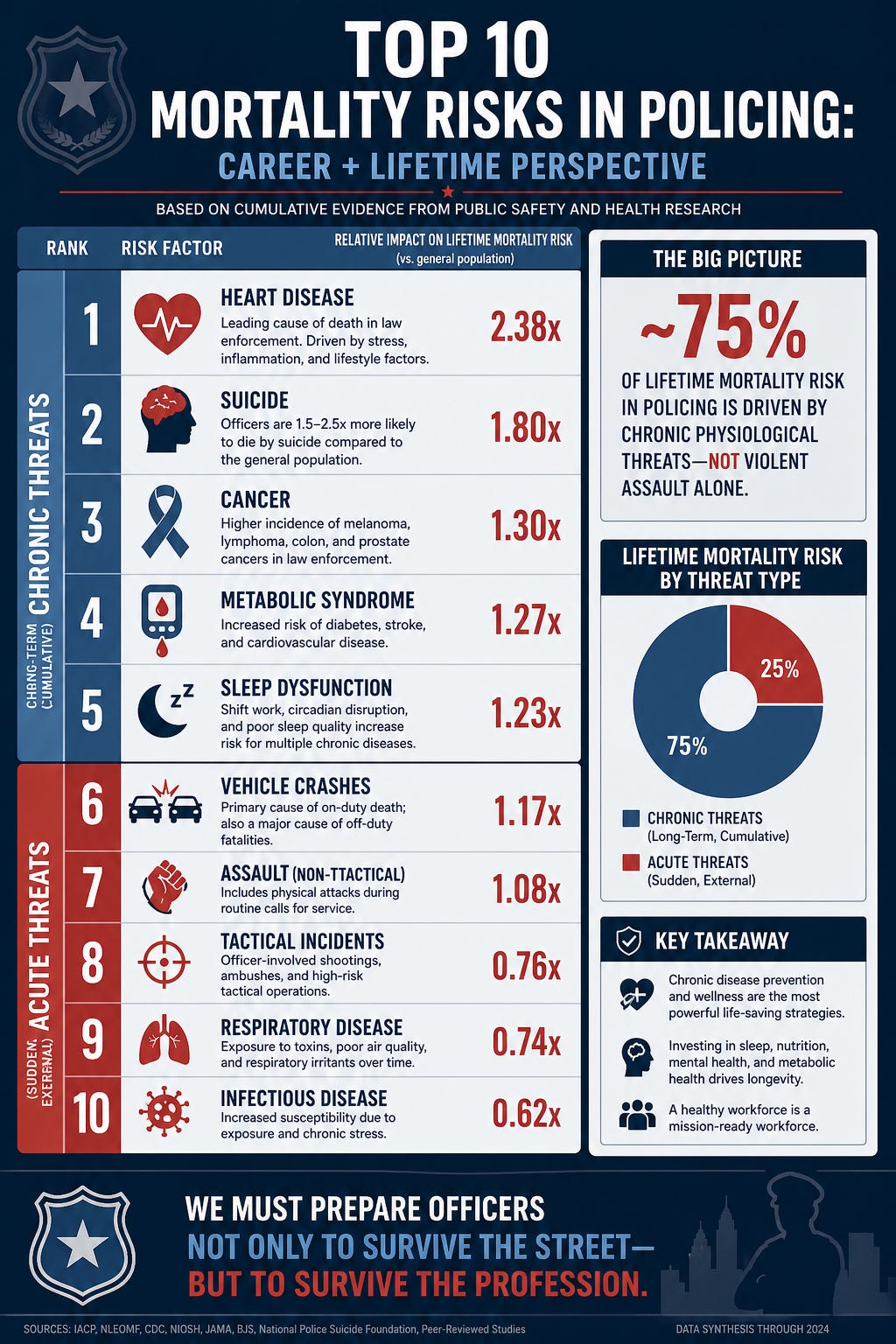
This is not an either-or proposition. This is a yes-and responsibility. We must prepare officers for acute and chronic threats simultaneously because both can kill and are deeply interconnected.
For decades, policing has understandably invested in visible readiness. We invest in firearms, Tasers, patrol rifles, SWAT, emergency vehicle operations, fleet upgrades, body armor, body cameras, drones, CAD systems, RTCCs, and technology ecosystems. These investments matter. They improve capability, increase capacity, and modernize policing.
But too often, we fail to ask a more foundational question:
What happens when all of that equipment, technology, and tactical preparation is placed into the hands of an officer whose internal operating system is degraded?
This is where the six inches between the ears must be redefined.
In modern policing, we obsess over hardware. We debate vehicles, optics, software, drones, and force options. But even the best hardware becomes compromised when the operating system running it begins to fail.
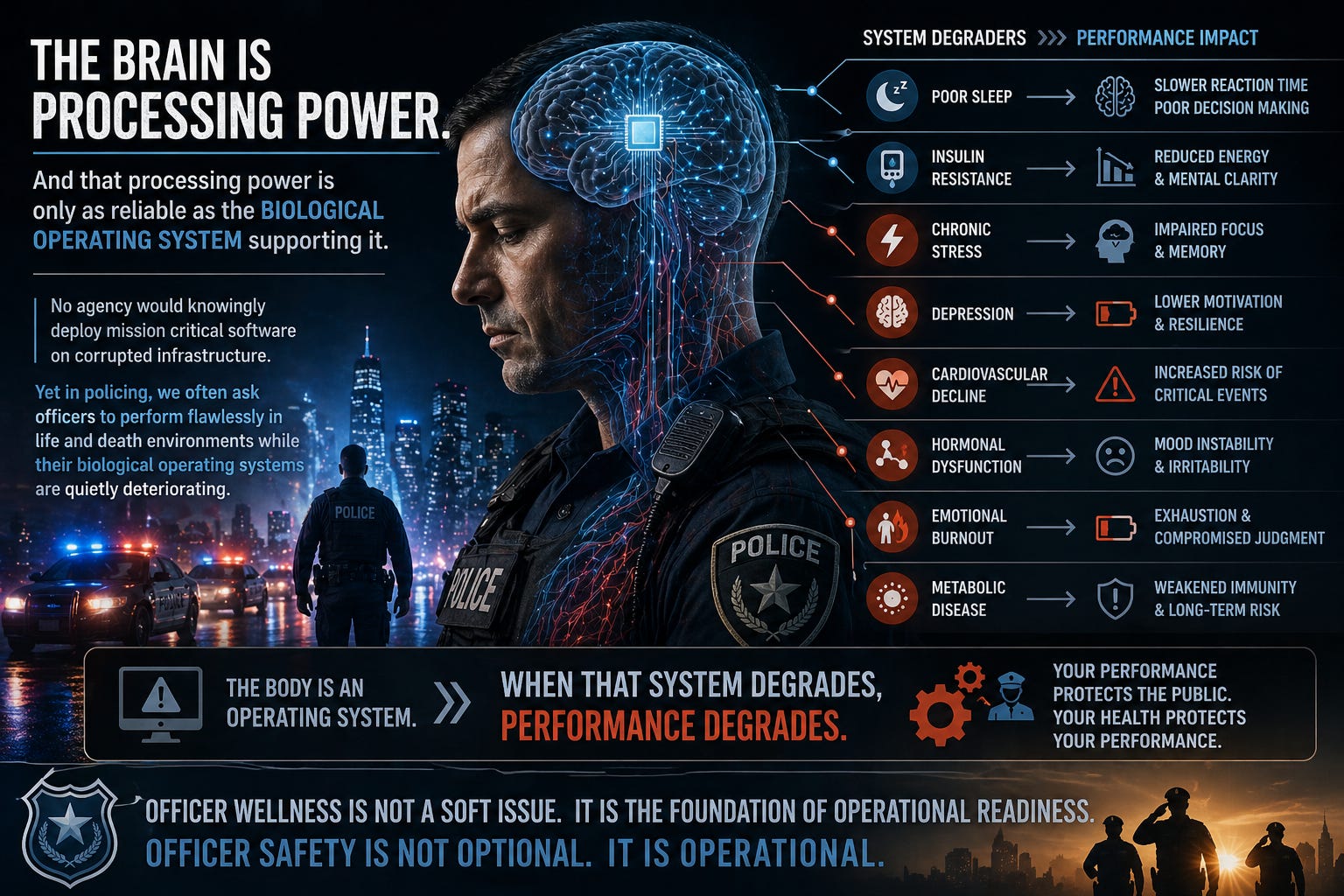
The brain is processing power.
And that processing power is only as reliable as the biological operating system supporting it.
Poor sleep, insulin resistance, chronic stress, depression, cardiovascular decline, hormonal dysfunction, emotional burnout, and metabolic disease are not abstract wellness concepts. They are system degraders. They impair judgment, reduce reaction speed, cloud cognition, weaken resilience, compromise emotional regulation, and increase the risk of catastrophic failure under pressure.
No agency would knowingly deploy mission-critical software on corrupted infrastructure. Yet in policing, we often ask officers to perform flawlessly in life-and-death environments while their biological operating systems are quietly deteriorating.
The body is an operating system.
When that system degrades, performance degrades. This is why officer wellness cannot be treated as a soft issue, a healthcare perk, or a public relations initiative.
Officer safety is not optional. It is operational.
A healthier officer is not simply less likely to die prematurely from cardiovascular disease or suicide. A healthier officer may also think more clearly, recover more effectively, regulate emotions more effectively, avoid burnout for longer, and potentially reduce the likelihood of tactical failure.
This is where leadership must confront a difficult truth.
It is easy to approve a new patrol vehicle, upgraded rifle optics, fleet modernization, or software contracts. These are visible investments. They are tangible, often popular, and culturally comfortable. But leadership is not defined by choosing only comfortable priorities. Leadership is defined by confronting system failures, especially when those failures are normalized.
And one of policing’s greatest normalized failures may be this:
We have often overtasked and under resourced the human being beneath the badge.
We ask officers to absorb trauma, survive shift work, endure sleep deprivation, maintain vigilance, suppress emotion, navigate family strain, and perform under extraordinary pressure for decades, often while providing more mandatory annual training around DEI and bloodborne pathogens than around insulin resistance, cardiovascular risk, or suicide physiology.
Then, when biology catches up, when performance declines, when the officer who devoted decades to the profession begins to struggle, the system too often defaults to a familiar pattern. We identify the symptoms, document the deficiency, initiate remediation, and if the decline continues, we move toward replacement. It is a model that may appear administratively efficient, but it often fails to ask the deeper question of whether the officer is truly broken, or whether the system has simply failed to recognize what years of cumulative physiological burden have done to the person carrying the mission.
This is precisely why Chief Corey Boxall’s story matters.
From Leadership to Lifeline: How Metabolic Health Saved a Career ft. Cory Boxell and Travis Bickel
When Officer Travis Bickel, a respected 25-year veteran, began to struggle, Chief Boxall stood at the same crossroads that many leaders eventually face. He could have chosen the conventional route. From a human resources perspective, the process might have seemed straightforward. Identify the issue. Apply discipline. Offer temporary remediation. If the officer fails again, move on.
For many organizations, that path would have been considered reasonable.
But convenience is not leadership.
What made Chief Boxall’s decision different was that he had already confronted a reality many leaders never personally experience. He participated in a unique opportunity presented to a group of Indiana Chiefs. Through the Metabolic Reset Program, he had examined his own bloodwork, physiological vulnerabilities, and biological operating system. He had moved beyond theory and into measurable understanding. He had learned firsthand that declining performance is not always a matter of motivation, discipline, or character. Sometimes, it is physiology. (To learn more about how this program has evolved, click the link below.)
SagaHealthCorp, Resilient Responder 360
That experience changed the questions he was willing to ask.
So when Travis began to struggle, Chief Boxall did not simply see a qualification issue or a performance problem. He saw the possibility that something deeper was happening beneath the surface. Instead of asking only how to correct behavior, he asked whether Travis’s biology, years of accumulated stress, sleep disruption, metabolic dysfunction, and physiological decline, had become part of the problem.
That question changed everything.
Rather than defaulting immediately to a break-and-replace culture, Chief Boxall chose to explore restoration. This was not about lowering standards or excusing poor performance. It was about recognizing that if the human operating system had degraded, then perhaps the answer was not simply punishment, but repair.
That distinction is where leadership becomes transformational.
Travis still had to decide whether to buy in. He still had to confront his own reality. He still had to do the work. No leader can do that part for another person. But because a leader was willing to look deeper, Travis was given something too many officers never receive when biology catches up with them: a path forward.
And that is why this story matters so profoundly.
This is not simply a story about one veteran officer improving his health or returning to duty. It is a story about what happens when leadership chooses systems thinking over surface judgment. It is about recognizing that behind every veteran officer is not just a payroll line, but decades of institutional knowledge, mentorship, field wisdom, community trust, family sacrifice, and cultural influence.
When Chief Boxall chose restoration over replacement, he was not merely helping one officer. He was protecting a 25-year investment. He was protecting human capital. He was protecting culture. He was protecting dignity.
And perhaps most importantly, he was interrupting a pattern of moral injury that policing too often overlooks.
Because one of the cruelest realities in this profession is that some officers survive the violence, survive the trauma, survive the long nights, and survive the decades of sacrifice, only to find themselves pushed toward the door at precisely the moment when the invisible toll of the profession begins showing up biologically.
At the very moment they should be understood, strategically supported, and restored, they are too often treated as if they have simply become the problem. That is not just a wellness failure. That is a systems failure.
And it is an expensive one.
Replacing an early-career officer may cost agencies between $150,000 and $300,000 for recruitment, academy costs, field training, salary, equipment, and onboarding. An agency that loses an officer in year 2 or 3 will never recoup those costs. But the financial burden of losing the wrong officer, a veteran officer, a mentor, a field trainer, a respected stabilizer, often extends far beyond what spreadsheets can fully measure.
At the same time, metabolically unhealthy employees may cost agencies between $15,000 and $60,000 annually through healthcare burden, absenteeism, overtime, productivity loss, disability, and attrition.
This means many agencies are already paying extraordinary sums. They are simply paying reactively instead of strategically.
This is why wellness is no longer merely a moral argument or agency “perk.” It is a fiscal argument, a readiness argument, a leadership argument, and a performance argument. It can’t be an “optional” job task for officers; they must be committed and accountable, and the resources must back it.
Because the officer is infrastructure.
The badge matters. The gun matters. The squad car matters. The software matters. But the biological operating system beneath the uniform determines whether all of those investments succeed or fail.
The future of policing may ultimately depend on whether leaders are willing to stop asking only whether they are buying the right equipment and start asking whether they are protecting the operating system that makes all equipment effective.
Because one day, every officer will hang up the gun belt, including Chiefs.
And leadership should not be measured solely by whether that officer survived violence. Leadership, in a shared system of accountability within their communities and agencies, should also be measured by whether that officer survived policing itself. Healthy enough in mind, body, and spirit to truly live after service.
That is the true return on investment.
Not simply dollars saved, but careers preserved, families protected, performance restored, institutional knowledge retained, and communities better served.
Broken systems break officers, but better systems can restore them. Wellness is not soft, nor is not optional.
Wellness is not separate from officer safety. Wellness is officer safety.
And if our budgets do not meaningfully invest in protecting the biological operating system beneath the badge, then we must ask ourselves a difficult question:
Are we truly prioritizing officer safety…
…or are we simply funding the illusion of it?