
Borders Matter
Part III of VII: Why Indiana Is No Longer Competing Against Itself

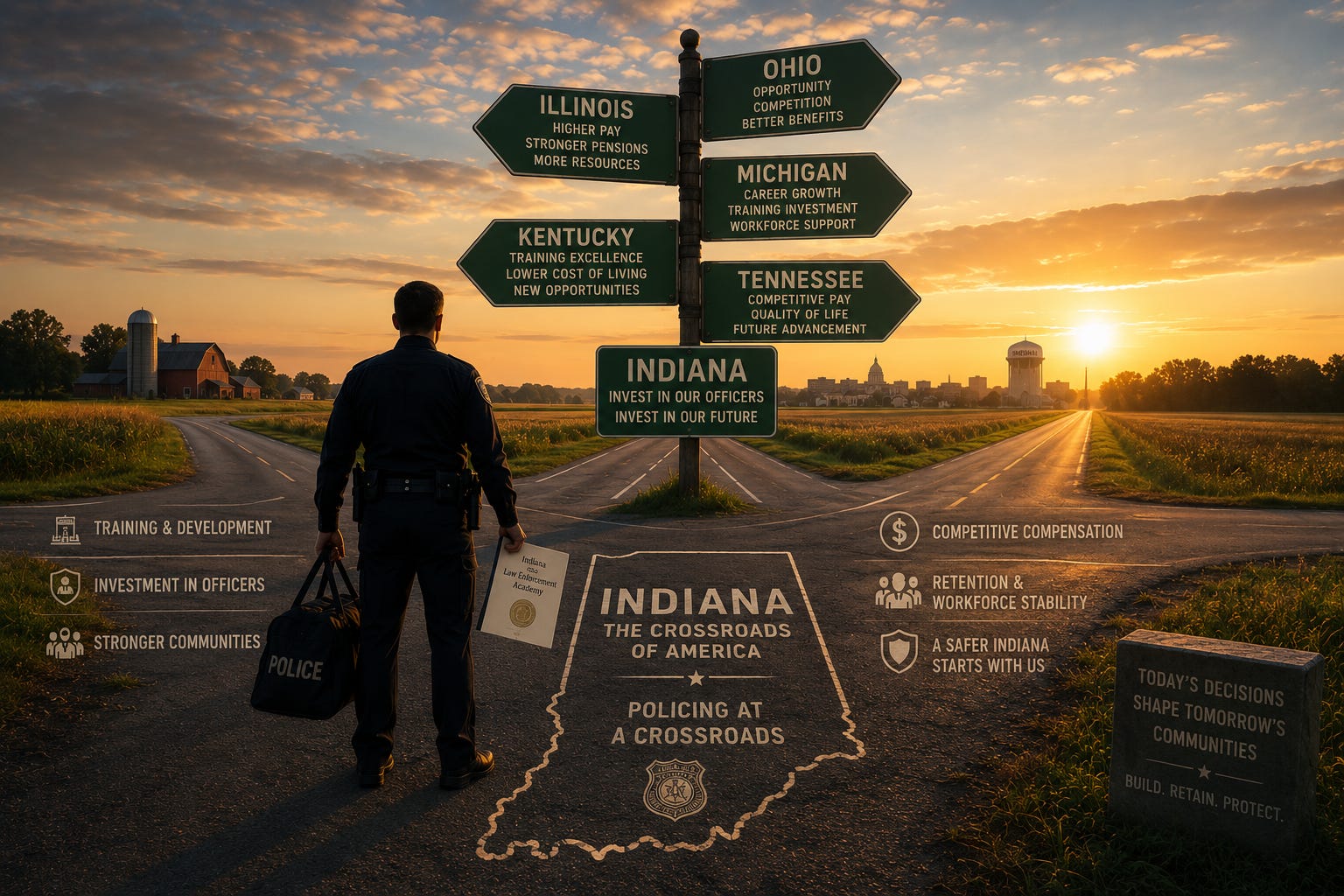
When I graduated from the Indiana Law Enforcement Academy in 1995, the idea of a police officer moving across state lines for better pay, better benefits, or better working conditions was relatively uncommon. Most officers built their careers close to home. Departments primarily recruited locally, and careers were largely defined by geography. The profession was different, and so was the labor market that shaped it.
That world no longer exists.
When most people hear the word “border” today, they picture the southern edge of the country. That is not the border I am worried about. The borders that could quietly drain Indiana of its police officers are the ones it shares with Illinois, Michigan, Ohio, and Kentucky, with Tennessee just a few hours away. Those lines on a map have become competitive fronts, and Indiana is not winning.
In Part I, I asked a simple question. Does Indiana understand the investment required to secure the future of public safety? In Part II, we worked through the 2019 Indiana Governor’s Task Force on Law Enforcement Training report, which asked and answered many of the right questions about that future. What troubles me is how few people seem to have opened it, including law enforcement leaders across the state. Today, in Part III, I want to look outward, at what the states around us are doing for their officers, and at what that competition means for Indiana.
With a few taps on the device resting in the hand of every officer graduating from the academy today, a young recruit can compare opportunities across an entire region before the ink dries on the certificate. Outside of the cop-to-cop discussions, salary schedules are public. Pension systems are public. Training and advancement opportunities are public. An applicant can learn more about an agency in fifteen minutes online than an earlier generation could learn in months. The competition for talent is no longer local. It is regional and, increasingly, national.
Recently, I came across an article that got me thinking: WalletHub’s 2026 report on the best and worst states to be a police officer. As a rule, I don’t pay much attention to lists like these, especially the “safest cities” rankings that usually amount to some real estate firm cherry-picking data. But I had to admit that if I were a young officer, this one would have caught my eye. Here is why.
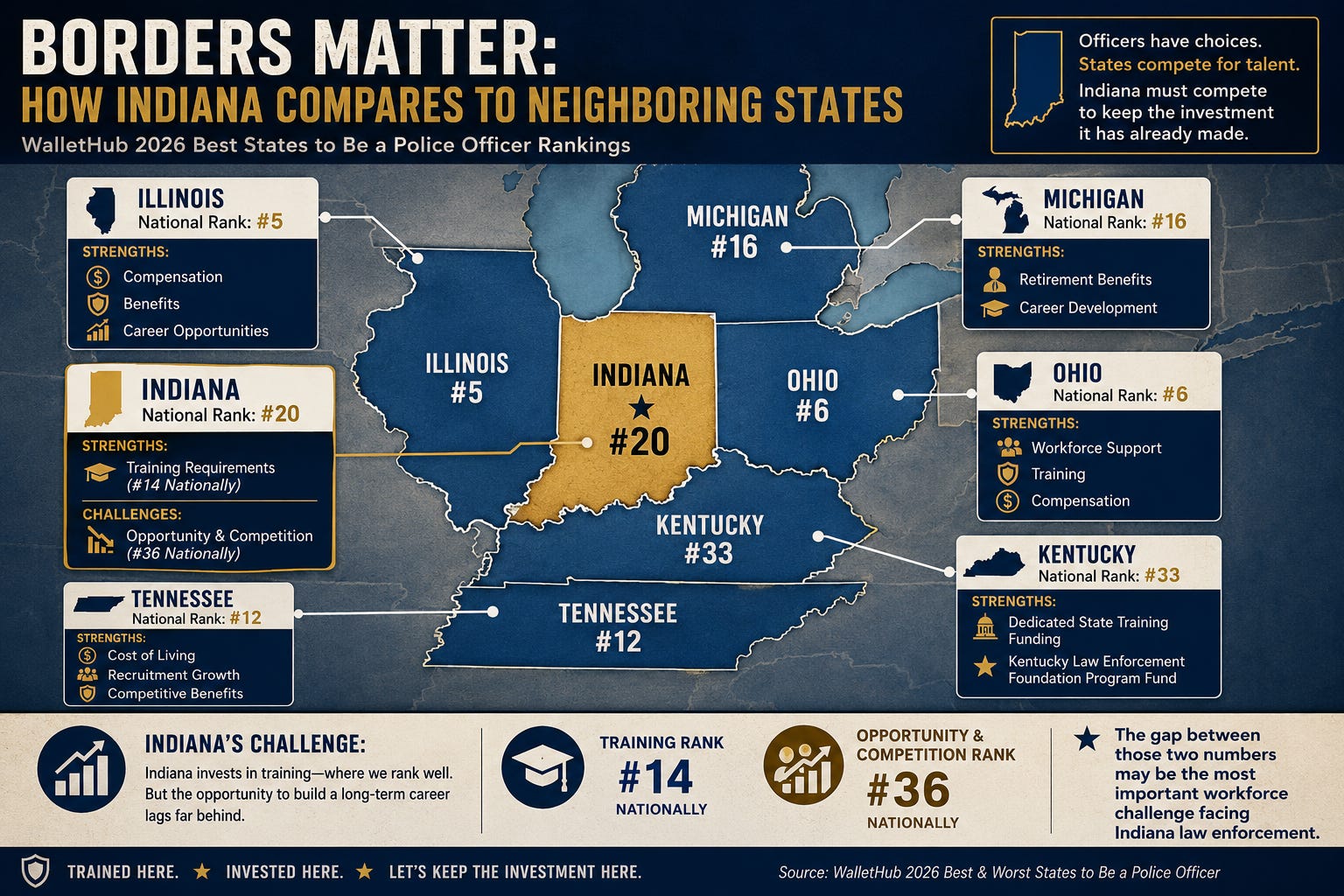
Ohio ranked 6th in the country. Illinois ranked 5th. Indiana landed at 20th out of 51, comfortably in the middle of the pack. Rankings like these are easy to dismiss as content built to generate clicks, and on the surface, that criticism has merit. Look beneath the headline, though, and the metrics tell a more useful story. The states that consistently perform well tend to invest in the same handful of areas: compensation, benefits, training, career development, workforce support, and the professional infrastructure that holds it all together. In other words, they invest in systems, and systems compete.
That same report makes the point sharper than I could on my own. It scores each state across three dimensions, and Indiana’s results are revealing. On training requirements, Indiana ranks 14th, which is respectable and consistent with a state that recently invested in its academy. On what the study calls opportunity and competition, the dimension built from salary, career growth, and staffing levels, Indiana ranks 36th.
The gap between those two numbers is the whole argument.
Indiana has been willing, albeit reluctantly and only when forced, to invest in that part of the system. The part that actually determines whether an officer stays or leaves has gone comparatively unaddressed. That should sound familiar to anyone who read the 2019 task force report. Although it focused on training infrastructure, its underlying logic extended well beyond the academy’s walls. The task force was describing capacity. Capacity to train, to develop, to retain, and to compete. The building was never really the point. The building was a proxy for a larger question: whether Indiana intends to treat its law enforcement workforce as an investment or an expense.
Public discussion still tends to miss the connective tissue here. Training, recruitment, retention, and compensation are not separate problems. They are components of a single workforce system, and a weakness in one of them tends to surface as a vacancy in another.
Return to that map for a moment. In the same study, Illinois ranked 5th, Ohio 6th, and Tennessee 12th, each ahead of Indiana and competing for the same public safety talent. Every one of those states is making its own decisions about pay, pensions, benefits, and training. The question facing Indiana is no longer whether it can recruit enough officers. The question is whether it can remain competitive with the states next door.
Every officer who leaves represents more than a vacancy. That officer represents an investment that walks out the door. Recruiting, background investigation, academy instruction, field training, equipment, supervision, and years of accumulated experience all leave at once. When an officer departs after three or four years for a better offer across a state line, the home agency absorbs the full cost of producing a professional that another state now gets to employ. That becomes a significant investment that is lost, generating no return.
In Indiana’s smaller agencies, this is even more punishing and harder to recover from. According to the Indiana Law Enforcement Academy’s 2024 strength report, 379 of the state’s county and municipal agencies employ ten or fewer full-time officers. In a department that size, losing a single officer strains operations, and losing two or three becomes a genuine crisis. National data tells the same story from another angle. The Bureau of Justice Statistics found that the smallest departments lose nearly twice the share of their officers to voluntary resignation as the largest departments do, which is exactly what you would expect when small agencies compete for talent against larger and better-resourced neighbors.
There are exceptions to every rule. Sometimes an agency benefits from what the research literature calls wandering officers, the professionals who move frequently from department to department. Hiring an already certified officer shortens the training cycle and can bring real relief to a short-staffed agency. But that mobility creates its own vulnerabilities, especially when an officer is moving for the wrong reasons rather than the right ones. There is also the occasional case of addition by subtraction, when a poor culture fit or a genuinely toxic officer moves on, and the organization is better for it. Those are outliers, though, and they do not change the larger pattern.
The core issue is investment, in the individual and in the organization. A sound investment attracts qualified officers, provides modern equipment and technology, supports basic and advanced training across the chain of command, and professionalizes the organization as a whole.
This brings the conversation back to the academy, and to the criticism that dominated the renovation debate. Most of that conversation fixated on the price tag. A more honest question is what it costs to fail to invest.
What does it cost to train an officer and then lose that officer to a state that offered a better future?
What does it cost to operate with chronic vacancies, or to ask small agencies to compete for talent without giving them the tools to win?
Treating workforce development as an expense rather than an investment carries a price as well. That price simply arrives later, and it arrives in the form of attrition.
Indiana had a recent and concrete chance to send the opposite signal. During the most recent legislative session, Senate Bill 69 proposed enhancements to the 1977 Police Officers’ and Firefighters’ Pension and Disability Fund, including an increase to the death benefit paid to a member’s family and added flexibility in the deferred retirement option program. The bill passed the Indiana Senate unanimously. It then stalled in the House, where it was recommitted to the Ways and Means Committee. I broke this down further, including the one small win the session did produce, in my Hoosier Public Safety Review.

Pensions are only one piece of the benefit picture. Another piece sits closer to the heart of officer wellness, which has been the focus of my work for years, and it is one Indiana has addressed only partway.
The job itself is hazardous in ways the public rarely sees. The greatest threat to an officer’s life over the length of a career is not a violent suspect. It is the officer’s own cardiovascular system. Cardiovascular disease is the leading cause of death among active and retired police officers. Clinicians and wellness researchers who work directly with departments put the contrast bluntly, estimating that officers are roughly 25 times more likely to die of a heart attack than to be killed by the violent act of a suspect, and that the average officer who suffers a heart attack does so around age 46. Peer-reviewed mortality research supports the direction of that claim, finding elevated rates of cardiovascular disease and cancer among law enforcement officers compared with the general population. The pattern holds for suicide as well, where federal data indicate that in recent years, more officers died by suicide than were killed by accidental and felonious events combined. Sometimes the profession has been measuring the wrong dangers, counting the rare and visible threats while the common and invisible ones do the most damage.
I have spent enough years around this profession to know that these are not abstractions. Behind each of those numbers is a name, a family, and a career that ended differently than anyone planned. The realization that I am now living in my post-law-enforcement life is that the expression "Life is Short" is not just a slogan on a T-shirt! I’ve already attended too many funerals of co-workers who should be enjoying their hard-earned retirement.
This is where policy and protection intersect. Many states extend what are called presumptive benefits to first responders, treating certain cancers and cardiovascular conditions as job-related for the purpose of disability and death benefits. Indiana is sometimes described as a state without that protection, and that is not entirely accurate. Indiana law provides a presumption, under Indiana Code 5-10-15, that certain cancers and heart, lung, or Parkinson’s disease in public safety employees were incurred in the line of duty. In fact, Indiana was the first state in the country to add Parkinson’s to its presumptive law, back in 2009, and that deserves real credit.
The trouble lies in the strength of the protection rather than its existence. The presumption can be rebutted by competent evidence; it applies only to officers diagnosed while employed or within 60 months of leaving, and, by the plain language of the statute, it does not, by itself, establish eligibility for disability benefits. The result is a protection that looks solid on paper and proves considerably narrower in practice. The real question is not whether Indiana has presumptive coverage. It is whether that coverage remains competitive as neighboring states continue to expand their benefit structures and workforce support. In a profession increasingly defined by interstate competition for talent, benefits are not merely a wellness issue. They are a workforce issue.
That reality comes into sharpest focus at retirement. Many police officers retire in their late forties or fifties, after twenty or thirty years of service, well before they become eligible for Medicare. They leave a profession that has often subjected their bodies to decades of shift work, sleep disruption, chronic stress, physical wear, and elevated exposure to occupational health risks. Yet for many retirees, some of the most expensive years of healthcare still lie ahead.
Maintaining health insurance through that gap can become one of the largest financial burdens a retired officer faces. The costs tied to cardiovascular disease, cancer screenings, orthopedic injuries, metabolic dysfunction, and other chronic conditions do not disappear when a career ends. In many cases, they become more apparent. The result is a hidden cost of policing that rarely shows up in budget discussions, pension debates, or recruitment brochures.
When policymakers weigh compensation and benefits, they tend to focus on salary, pensions, and the immediate budget. Officers deciding whether to remain in the profession or move to another agency often view the equation differently. They are looking at the entire arc of a career, including what happens after the badge comes off. The states that recognize and address those realities gain an edge in recruiting and keeping experienced professionals. The states that do not may find themselves losing talent to jurisdictions that offer stronger long-term support for the people who spent their careers protecting others.
There is a labor dimension to this as well, and it is worth naming plainly even though reasonable people will disagree about it. Indiana has been a right-to-work state since 2012. That status reflects a genuine and widely held preference for less regulation and greater individual liberty, and I understand its appeal. My concern is narrower and rooted in occupational health. The protections that matter most to an aging workforce, things like stronger presumptive coverage, durable pensions, and meaningful wellness support, are typically secured through sustained collective advocacy. Where that advocacy is weaker, officers can end up backing a policy framework that does not fully account for how physically punishing their own profession is. The work is hard on the body in measurable ways, and the benefit structure should reflect that reality regardless of whether the politics make it convenient. The emotional appeal of “cut my taxes” and “give me my 2nd amendment rights” speaks to the personality types of cops, yet voting to support that legislative position is often contrary to their own best interests.
None of this is unique to policing. Hospitals compete for nurses, airlines for pilots, universities for faculty, school systems for teachers, and technology firms for engineers, and each of those industries has learned to treat its workforce as a system to be built rather than a cost to be managed. Public safety has been slower to make that shift. It still tends to treat recruiting shortfalls, retention problems, and benefit gaps as separate and unrelated events rather than as symptoms of the same underlying condition.
The states performing best understand the simple version of all this. Talent follows opportunity, and opportunity is shaped by investment. The 2019 task force understood it too. The academy renovation was a real and necessary step toward building the capacity Indiana needs, but it was only one step, and the larger work remains. Indiana still has to build a system that lets it attract, develop, protect, and retain the professionals its communities expect.
Because borders matter. In a competitive labor market, officers have choices, and if the last decade has taught us anything, it’s that they are increasingly willing to act on them. The states that recognize this will be the ones positioned to build the public safety workforce of the future. The states that ignore it may find that they have been training officers for someone else’s benefit.
Next in the Series
If workforce competition is the challenge, how should Indiana fund the solution? In Part IV, we turn to Kentucky’s dedicated law enforcement training fund and ask a straightforward question. Did Indiana solve the academy problem without ever solving the funding problem?
About the Author
Patrick Flannelly, the founder of The Coptimizer Podcast and Hoosier Public Safety Review Newsletter, is a retired Chief of Police from the Lafayette, Indiana Police Department, where he served for 27 years, including a decade as Chief. A graduate of the Indiana Law Enforcement Academy Class 95-122, he later served as an appointee to the Indiana Law Enforcement Training Board under Governor Eric Holcomb during the period in which many of the recommendations discussed in this series were being evaluated and implemented.
Throughout his career, Patrick served on local, state, and national law enforcement committees focused on leadership, officer safety, wellness, training, and organizational performance. Today, he works as a public safety consultant, instructor, and writer, helping agencies navigate the challenges of workforce development, technology, leadership, and officer wellness.
The purpose of this series is not to advocate for bigger budgets or defend past decisions. It is to examine a fundamental question: If society expects professional policing, what investments are required to build and sustain professional systems?
Future installments will explore training, recruitment, retention, compensation, wellness, funding models, and the role public safety plays in the long-term success of Indiana communities.
Sources
WalletHub, Best & Worst States to Be a Police Officer (2026 edition).
Indiana Law Enforcement Academy, 2024 Law Enforcement Agency Strength Report (statistics as of April 1, 2025).
U.S. Bureau of Justice Statistics, Hiring and Retention of State and Local Law Enforcement Officers, 2020.
Indiana General Assembly, Senate Bill 69 (2026 session), 1977 Police Officers’ and Firefighters’ Pension and Disability Fund.
Indiana Code 5-10-15, Emergency and Public Safety Employee Disability From Certain Cancers or Heart, Lung, or Parkinson’s Disease Presumed Incurred in the Line of Duty (Parkinson’s added 2009 under IC 5-10-15-5.5).
National Occupational Mortality Surveillance analysis of law enforcement mortality (2025); cardiovascular-risk commentary via Police1 and Sigma Tactical Wellness.
U.S. Department of Justice and Blue H.E.L.P. data on officer suicide, 2017 to 2019.